

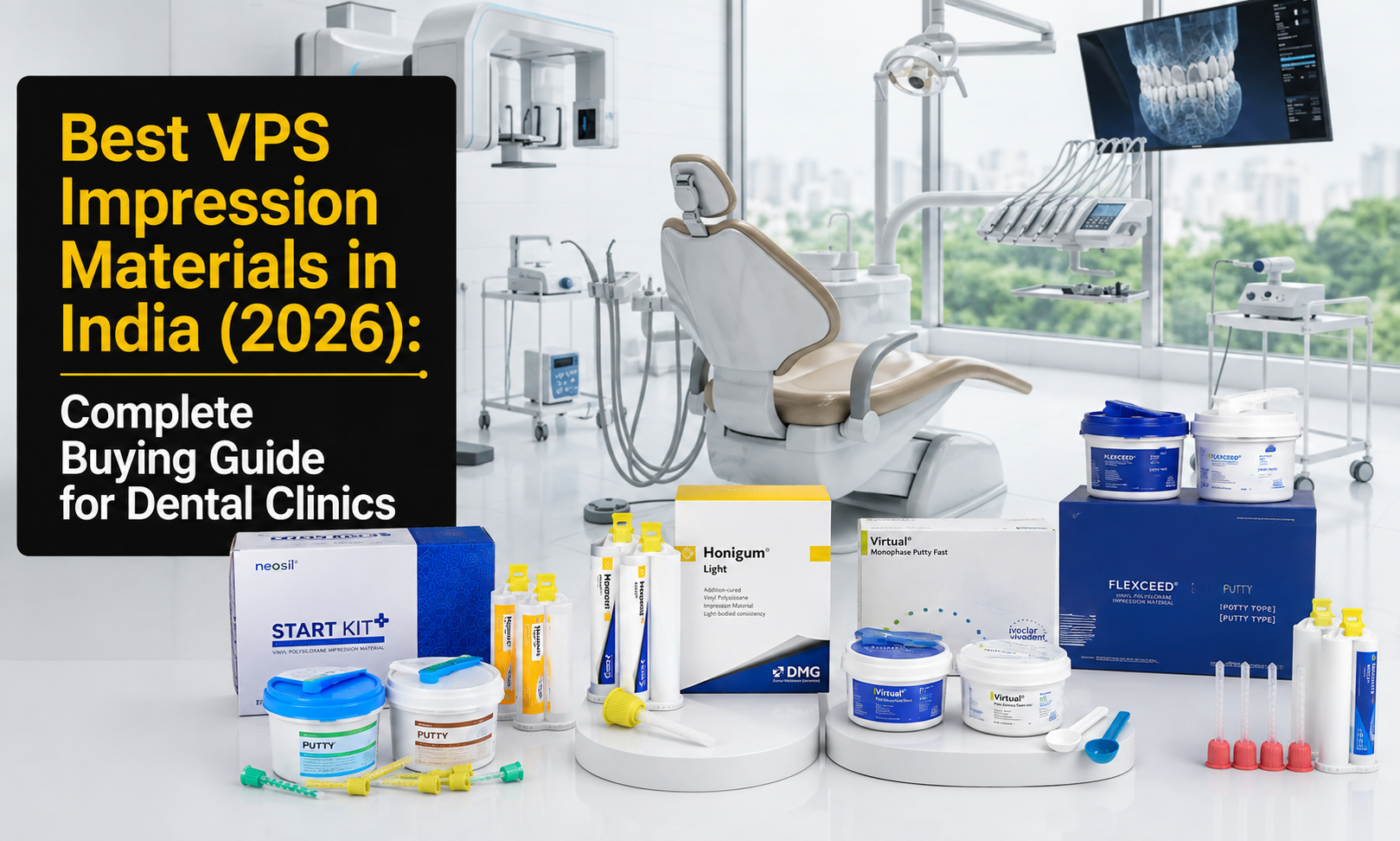
Best VPS Impression Materials in India (2026): Complete Buying Guide for Dental Clinics
If you're still stocking whatever VPS impression material in India your rep pushed on you last renewal cycle rather than actually comparing viscosity, working time, and hydrophilicity across brands, you're leaving accuracy on the table for no reason. Final impressions for crown and bridge work only get one honest shot before you're either happy with the die or calling the patient back - and which VPS system sits in your operatory drawer has more influence on that outcome than most of us give it credit for. This guide walks through the putty, light body, and monophase options actually worth stocking, how the major brands differ in handling, and where the real cost tradeoffs are.
Why VPS Impression Material in India Still Dominates Final Impressions
Addition silicone remains the clinical standard against which every "digital-first" claim gets measured, and for good reason. Unlike condensation silicone, VPS polymerises without releasing a byproduct - no ethanol evaporation, no post-set shrinkage creeping in over the hours before you pour the model. That dimensional stability is what lets you courier an impression to an outstation lab without worrying about the die being distorted by the time it arrives.
Hydrophilicity is the second reason it hasn't been displaced. A field with even minor sulcular bleeding or seepage still needs a wettable material to capture the margin cleanly, and modern VPS formulations handle that far better than their predecessors did a decade ago. If you're doing single-unit crowns through full-arch fixed prosthodontic cases, VPS is still where your money should go first - digital scanning is excellent chairside. However, plenty of Indian labs are still print/mill workflows built around a physical impression.
This is exactly why choosing the right VPS impression material in India matters more than most clinicians assume - the wrong system can undo an otherwise clean prep.
Putty, Light Body, or Monophase: Picking the Right Viscosity
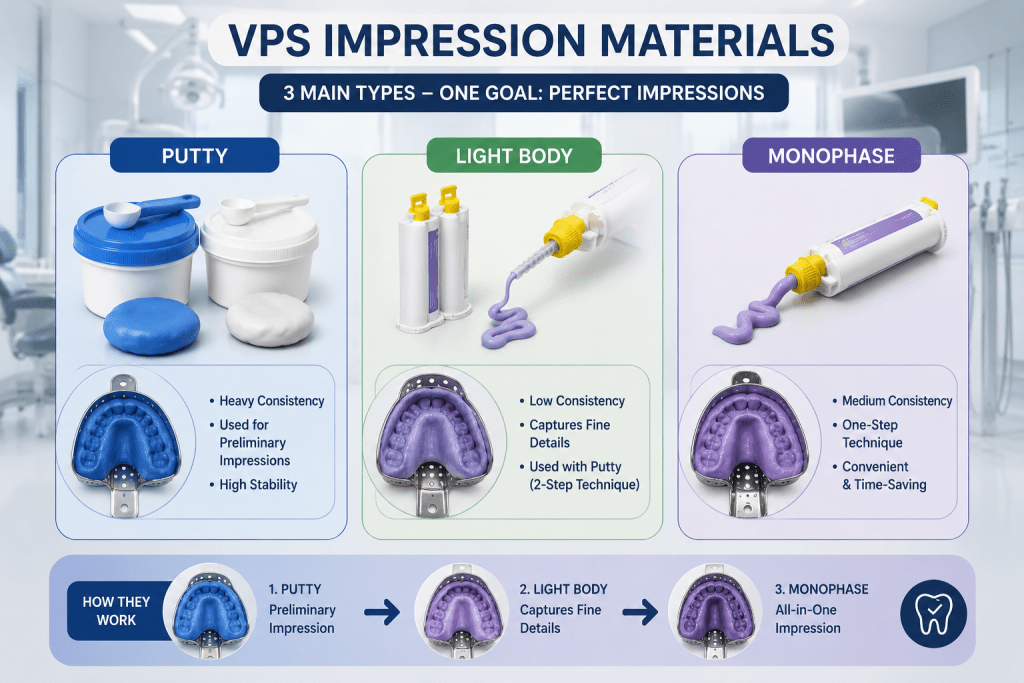
This is where most of the confusion actually lives, not in brand selection. The three viscosity classes solve different problems:
Putty (heavy body) creates the primary/tray impression and displaces tissue and saliva out of the way. It's not meant to capture fine detail - it's meant to give the wash material somewhere accurate to sit.
Light body (wash) is syringed directly around the prep and into the sulcus. This is your detail-capture material, and it's the one where hydrophilicity actually matters clinically - a light body that beads up around a slightly moist margin will cost you a remake.
Monophase materials (like 3M's polyether option) skip the two-step logic entirely - one viscosity does both tray and syringe duty. It trades some of the putty's displacement force for a simpler one-material workflow, which suits high-volume clinics that don't want two separate cartridge systems in rotation.
If you're running a single-step tray/wash technique, you want a true putty-light body pairing designed for it, not two viscosities from different systems mixed - cross-brand compatibility is inconsistent enough that it's not worth the risk on a final impression.
Brand-by-Brand: Comparing VPS Impression Material in India
Not every VPS impression material in India performs the same way once you factor in Indian clinic conditions - ambient humidity, courier time to outstation labs, and shelf storage all play a role.
| Brand / Product | Viscosity Type | Best For | Notable Trait |
| 3M ESPE Express XT Light Body | Light body wash | Crown & bridge detail capture | Strong hydrophilicity, proven track record |
| 3M ESPE Soft Putty VPS | Putty (hand-mix) | Primary/tray impression | Economical hand-mix option |
| 3M Express XT Putty Soft VPS | Putty, full kit | Complete impression system | Comes as a full kit with dispenser gun |
| 3M ESPE Impregum Soft Medium Body | Polyether, medium body | Fixed prosthodontics needing rigidity | Polyether stiffness aids in undercut-free cases |
| 3M Mono Phase Polyether | Monophase polyether | Single-material workflow | One viscosity for tray + syringe |
| GC Flexceed Putty and Kit | Putty + wash kit | General fixed prosthodontics | Balanced elasticity, mid-range pricing |
| Ivoclar Virtual A Silicone Kit | A-silicone, multi-viscosity | Clinics wanting one brand ecosystem | Available across a price range depending on kit size |
| DMG Honigum Putty & Light Body | Putty + light body | High-accuracy implant and crown work | Premium tier, higher upfront cost |
| IVO Peakosil Kit | Bite registration + VPS | Occlusal registration alongside impressions | Doubles as a bite registration set |
3M's range dominates by sheer breadth - you can build an entire putty/light body/polyether workflow within one brand and one dispenser system, which matters if you're trying to minimize the number of mixing tip and gun formats floating around your operatory. GC and Voco sit in a comparable mid-tier bracket on cost, while DMG's Honigum line is the one to reach for when a case genuinely demands the tightest dimensional accuracy you can get - implant-level work, multi-unit bridges, anything where a die that's off by a fraction costs you a lab remake.
Handling Notes That Actually Affect Outcomes
A few technique points worth reinforcing, not because you don't know them, but because they're where most VPS failures actually originate:
Working time and setting time aren't the same across "regular" and "fast" set variants of the same product - check which one you've stocked before you're mid-procedure with a nervous patient. Contamination from latex gloves is still a real issue with some VPS chemistries; nitrile is the safer default if you're not certain your brand is latex-tolerant. And multiple-pour capability varies enough between brands that if your lab needs a second pour for a working model plus a solid cast, confirm that specific product supports it rather than assuming all VPS behaves the same on that front.
Cost vs. Case Volume: What's Actually Worth Stocking
For a general practice doing occasional crown and bridge work, a mid-tier system - GC Flexceed or Voco Individo Lux - covers most cases without tying up working capital in a premium product you're not using fast enough to justify the shelf life. For a practice doing volume fixed prosthodontics or implant restorations where remakes are genuinely costly, DMG Honigum or the 3M Impregum polyether line earn their higher price through fewer retakes. If you already stock GIC or resin cement from your restorative shelf, VPS is a separate line item entirely - don't assume any crossover in sourcing.
Getting this decision right is really about matching the right VPS impression material in India to your actual case mix, not chasing whichever brand has the best margin for your rep.
As a dedicated supplier of VPS impression material in India, we stock the full range by brand and viscosity, so whether you're topping up a specific light-body cartridge or setting up a new prosthodontics workflow from scratch, you can buy individual products rather than being locked into a bundle you don't need.
FAQs
Is polyether or VPS better for crown and bridge impressions?
How long can a VPS impression sit before pouring without dimensional distortion?
Can I mix putty from one brand with light body from another?
Does VPS impression material need refrigeration for storage?
If you're restocking or building out a prosthodontics workflow from scratch, browse the full range of impression materials on Dentosky by brand, viscosity, and setting time.