

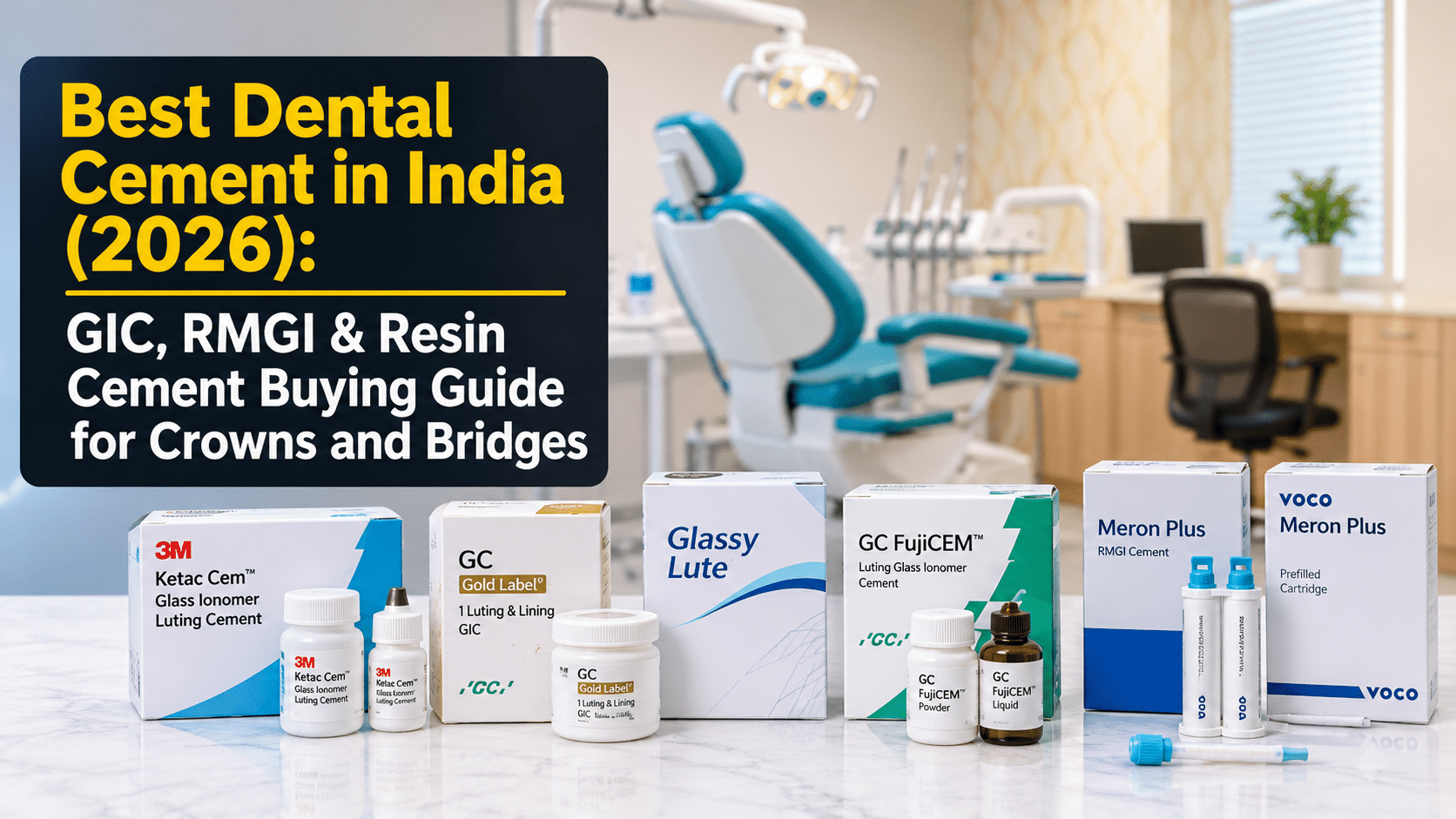
Best Dental Cement in India (2026): GIC, RMGI & Resin Cement Buying Guide for Crowns and Bridges
Cement choice decides whether a well-prepped crown stays put for ten years or comes back in six months, yet most of us still reach for whatever is on the shelf. Choosing the right dental cement in India is harder than it looks: conventional GIC, RMGI, self-adhesive resin and fully adhesive resin systems are all available, priced from a few hundred rupees to over ₹20,000 a pack, and they are not interchangeable. This guide sorts them by what you are actually cementing, so you can stock two or three cements properly instead of eight badly.
Match the Dental Cement in India to the Restoration First
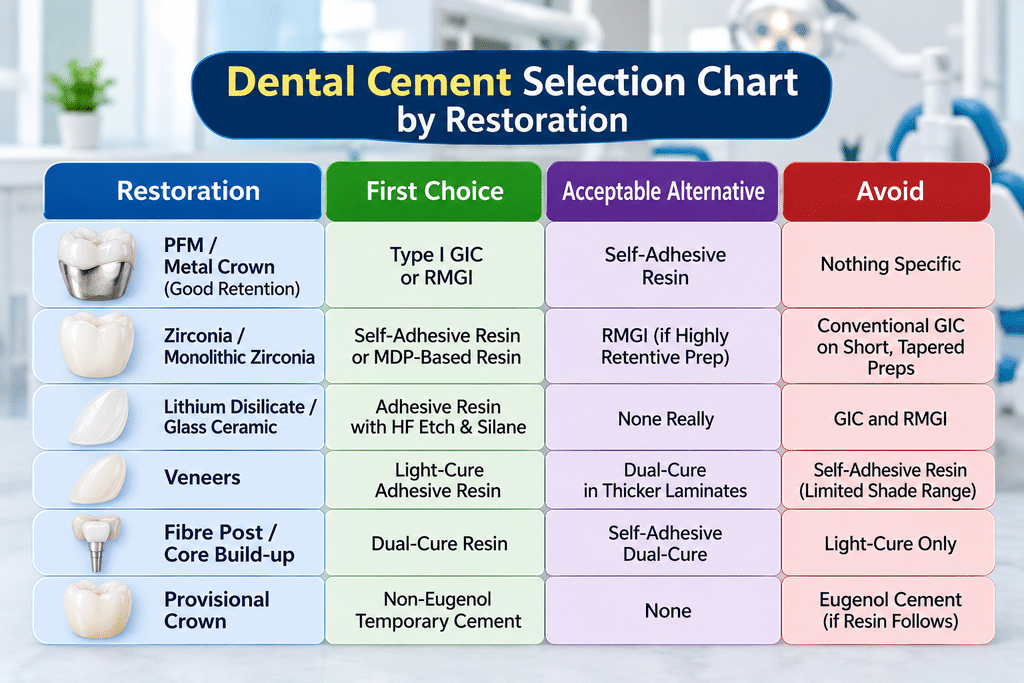
Start from the restoration material and the retention of your preparation, not from the brand. For any dental cement in India, this is the logic I use chairside:
Conventional GIC: Still Worth Keeping
Do not write off conventional glass ionomer. For metal and PFM crowns on well-retentive preparations, a Type I luting GIC gives chemical bonding to dentine, fluoride release and forgiving handling when isolation is not perfect. Its weaknesses are known: early moisture sensitivity, higher solubility in the first hours and lower strength than resin.
The range of GIC dental cement in India is wide. 3M ESPE Ketac Cem and GC Gold Label 1 Luting & Lining GIC are the established references. Secure Lute 1 and Glassy Lute sit lower in price, and a basic glass ionomer luting cement is available at ₹350 for high-volume work. Whatever you choose, protect the margin from moisture for the first few minutes and apply the coating after it sets.
RMGI: The Practical Middle Ground
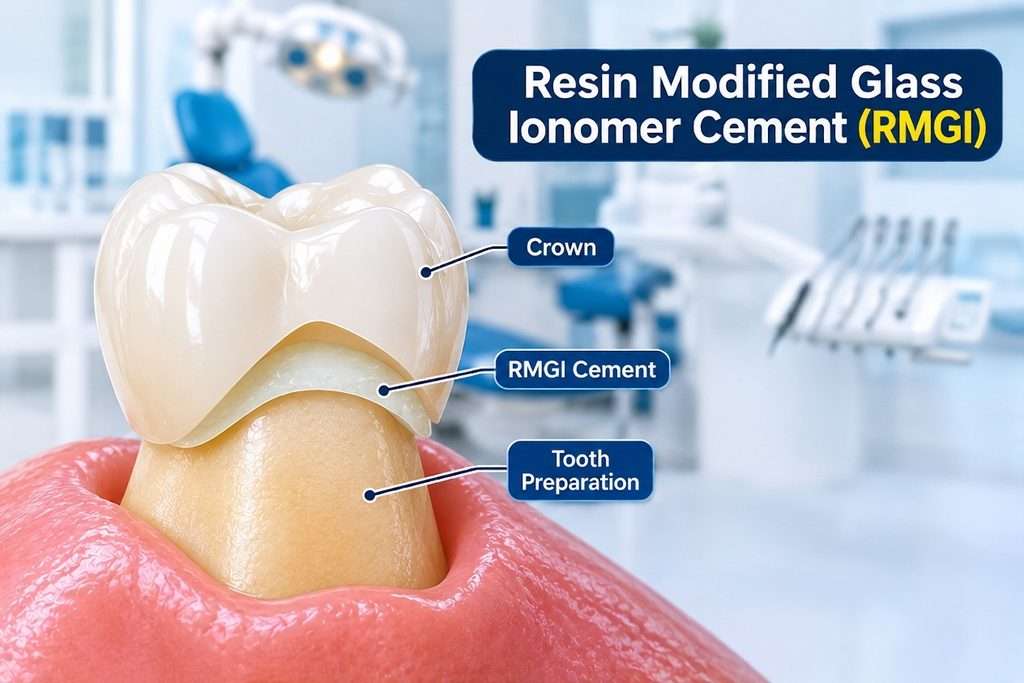
Resin-modified GIC gives you better early strength, lower solubility and, in my experience, less post-cementation sensitivity than conventional GIC, with the same fluoride release. It suits metal-ceramic crowns, bridges and high-strength ceramics on retentive preparations. It is not the cement for thin glass-ceramic restorations, because hygroscopic expansion has been linked to fracture in all-ceramic crowns.
For RMGI dental cement in India, 3M ESPE RelyX Luting 2 and GC FujiCem are the benchmark choices. Other options include Secure Lute RMGI, Shofu Hy-Bond Resiglass, and Voco Meron Plus. You can compare the full range under RMGI cements.
Resin Cements: Adhesive vs Self-Adhesive
Resin cement is where the price of dental cement in India jumps, and so does the technique sensitivity. The split matters clinically.
Adhesive (etch-and-rinse or primer-based) systems such as RelyX Ultimate, Ivoclar Multilink N and Panavia V5 give the highest bond strengths. They are the right choice for lithium disilicate, veneers and any short or low-retention preparation. The price is a longer protocol: etch, prime, silanate, bond, then cement.
Self-adhesive systems such as RelyX U200, SpeedCEM Plus and Bifix SE skip the separate dentine conditioning step. They are well suited to zirconia, metal and fibre posts, where an MDP-containing cement or primer bonds reliably to the restoration surface. Their weakness is enamel: bond strength is lower than with a full etch, so I would not rely on them for marginal enamel on a short preparation.
For veneers, a light-cure cement such as RelyX Veneer or Variolink N LC gives you working time and colour control. For a lower-cost dual-cure option, Prevest Fusion Ultra D/C is priced at ₹1,398, though I would trial it on a few cases before switching your zirconia work to it.
Do not forget the conditioners. Any resin-based dental cement in India is only as good as the surface treatment, so budget for ceramic etching gel and Monobond alongside the cement.
How to Choose Dental Cement in India: Price and Use at a Glance
| Cement type | Examples | Typical pack price | Best for | Main limitation |
|---|---|---|---|---|
| Conventional GIC | Ketac Cem, Gold Label 1 | ₹350 to ₹3,255 | PFM, metal, retentive preps | Moisture sensitive, soluble early |
| RMGI | RelyX Luting 2, Fujicem | ₹1,221 to ₹4,999 | PFM, bridges, high-strength ceramics | Not for thin glass ceramics |
| Self-adhesive resin | RelyX U200, SpeedCEM Plus | ₹6,480 to ₹7,499 | Zirconia, metal, posts | Weaker enamel bond |
| Adhesive resin | RelyX Ultimate, Multilink N | ₹6,999 to ₹8,777 | Glass ceramics, veneers, short preps | Multi-step, technique sensitive |
Prices are the current listings at the time of writing and will change with offers. A sourcing note: every dental cement in India option above is available on Dentosky, so you can check current pack sizes and pricing before you decide what goes into your clinic stock.
Think Cost per Case, Not Cost per Pack
A ₹350 glass ionomer and a ₹8,777 resin system look far apart on the invoice, but the comparison only makes sense per restoration. One resin pack cements a large number of units, and the real cost sits in the primers, etching gel and silane you add on top. A cheap cement that debonds means a remake, a lost chair slot and an unhappy patient, which costs more than any pack. At the same time, paying for an adhesive resin system to seat a metal crown on a long, retentive preparation is money you do not need to spend. Even the cheapest dental cement in India is the right answer for the right case, and the most expensive one is the wrong answer for the wrong case.
Retention, Film Thickness and Seating
Before you blame your dental cement in India, look at the preparation. Taper, height and surface area decide how much retention the cement has to provide. On a short or over-tapered preparation, a conventional GIC will struggle, while a resin cement can compensate. Film thickness matters too: a cement that does not allow full seating changes the occlusion and opens the margin, whatever its bond strength on paper. Use a die spacer sensibly, vent the intaglio where you can, and seat under steady finger pressure until the cement has set.
Do Not Let the Provisional Cement Undo Your Final One
Eugenol inhibits resin polymerisation, so if your final restoration is going to be resin-cemented, use a non-eugenol provisional cement. RelyX Temp NE and Prevest Oratemp NE are both non-eugenol, and cleaning the preparation before final cementation matters just as much. To be fair, the evidence is not uniform: an in-vitro study on a metal substrate found eugenol was not a determining factor in the bond strength of a self-adhesive cement. Most of what we cement to is dentine, so I still default to non-eugenol. Details on the full range are under temporary cementation.
Cementing Bridges and Long Spans
Bridges multiply every cementation error, because each retainer has to seat fully at the same time. Choose a dental cement in India with adequate working time, ideally one you can mix and load without rushing, and check the connectors and occlusion before the cement sets. For multi-unit zirconia work on retentive abutments, a self-adhesive resin cement is usually the practical choice; for metal-ceramic bridges, a Type I GIC or RMGI remains perfectly sound. Seat, confirm, then clean up, and give the patient a short, clear instruction to avoid sticky food for the first day.
Technique Errors That Cause Most Failures
Most debonded crowns I see are technique problems, not product problems, whichever dental cement in India you use.
- Contaminated surfaces. Saliva or blood on a silanated or etched surface ruins the bond. Isolate properly, and re-treat if contamination occurs.
- Wrong order of steps. Silane before etch, or bonding agent on a restoration that needed only primer, wastes the whole protocol.
- Excess cement left at the margin. Remove it at the gel stage with a light-cure tack, not after full set.
- Skipping the dry try-in. Check fit, contacts and occlusion before any conditioning. Once the restoration is etched and silanated, a second try-in with saliva contaminates it.
- Ignoring shelf life and storage. Opened capsules, expired liquids and warm storage change setting time. Rotate your stock.
Frequently Asked Questions
Can I use GIC for zirconia crowns?
Is self-adhesive resin cement enough for lithium disilicate?
Why do I get sensitivity after cementing a crown?
Do I need a separate cement for posts?
Final Word
If I had to keep it simple, I would stock one Type I GIC or RMGI for metal-based work, one self-adhesive resin for zirconia and posts, and one adhesive resin system with its conditioners for glass ceramics and veneers. That covers nearly every case, and it makes buying dental cement in India far less confusing than choosing by brand. You can browse the full range at Dentosky under cementation, with GIC and resin cement listed separately.